Holy Intercession Monastery
The first stone building of the temple was built in 1604 by Lev Sapieha. In 1615, he donated 5 plots of land with five peasant households in the village of Katuzhino to the church. In 1726 the church was handed over to the Uniates. In 1769, in its place, the Sangushko magnates erected a new building in the Vilna Baroque style. Since then, the temple has not been rebuilt. All of its designs and decorative elements are authentic. The church has never closed and has always been active. Here is placed the rarest stone iconostasis in Belarus. In 2012, the temple was reconstructed. Money was needed to replace the huge windows. The Russian singer Philip Kirkorov helped to collect them. He posted a request for help to the Tolochin temple on his website.
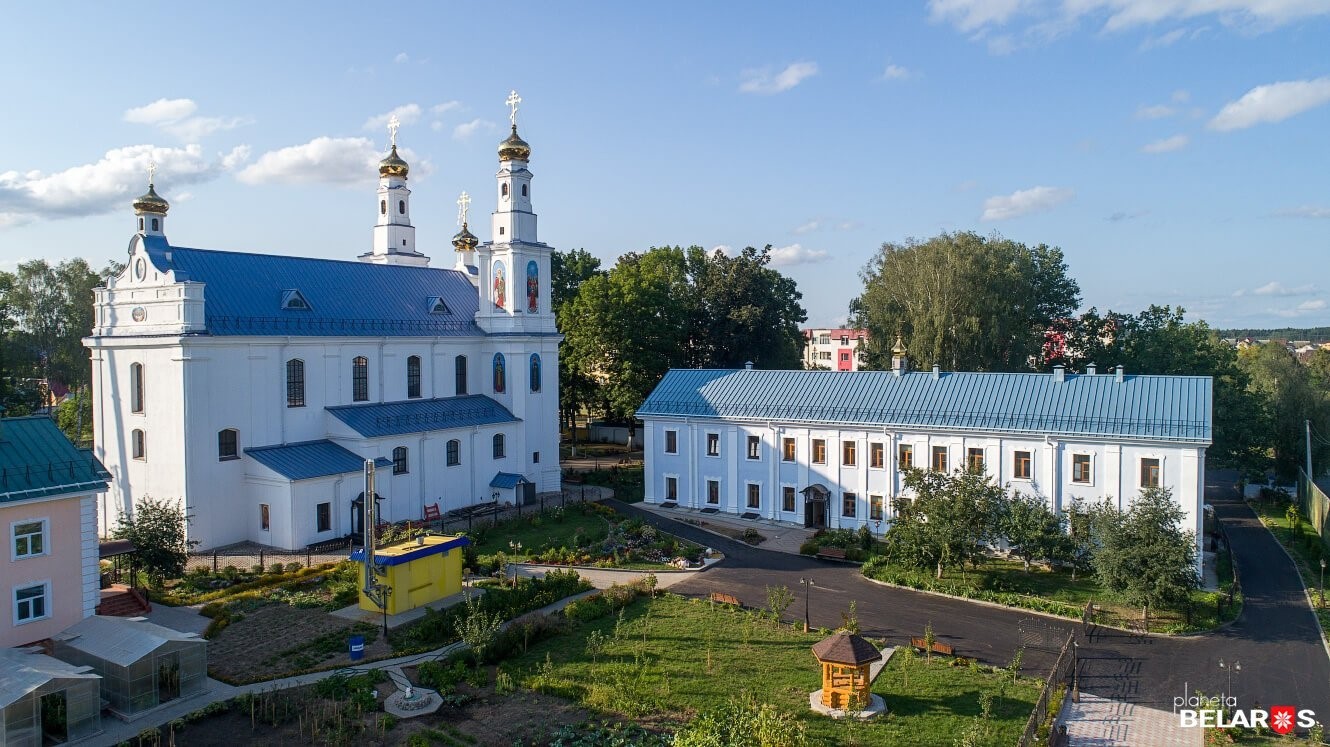
In 1779, a monastic building with living quarters, a refectory and a “warm church” was built at the temple. In 1804 the complex was transferred to the Orthodox Church. Napoleon spent the night in one of the premises of the monastery in 1812. He was accompanied by the Neapolitan king Murat, the viceroy of Italy, Eugene de Beauharnais, marshals Ney and Mortier, and other generals. Having received news of the capture by the Russians of the Borisov bridge cover on the Berezina, through which the French were to cross, the emperor of France ordered the army archives, corps emblems, carriages and wagons with looted goods to be burned. Unfortunately, the French completely plundered the church and monastery. They say that during the Second World War, German military officials always tried to come here to look at the place where the great emperor spent the night.
Once on the territory of the complex there were underground passages, so spacious that a convoy with a horse could freely pass through them. They connected the nursing building with the church, led to the church and the Orsha cemetery. In Soviet times, the tunnels began to collapse, so they were covered up.